From Choreographer to Defense Tech CEO
Featuring Guest Contributor: Sheila Harding of HoloTerra

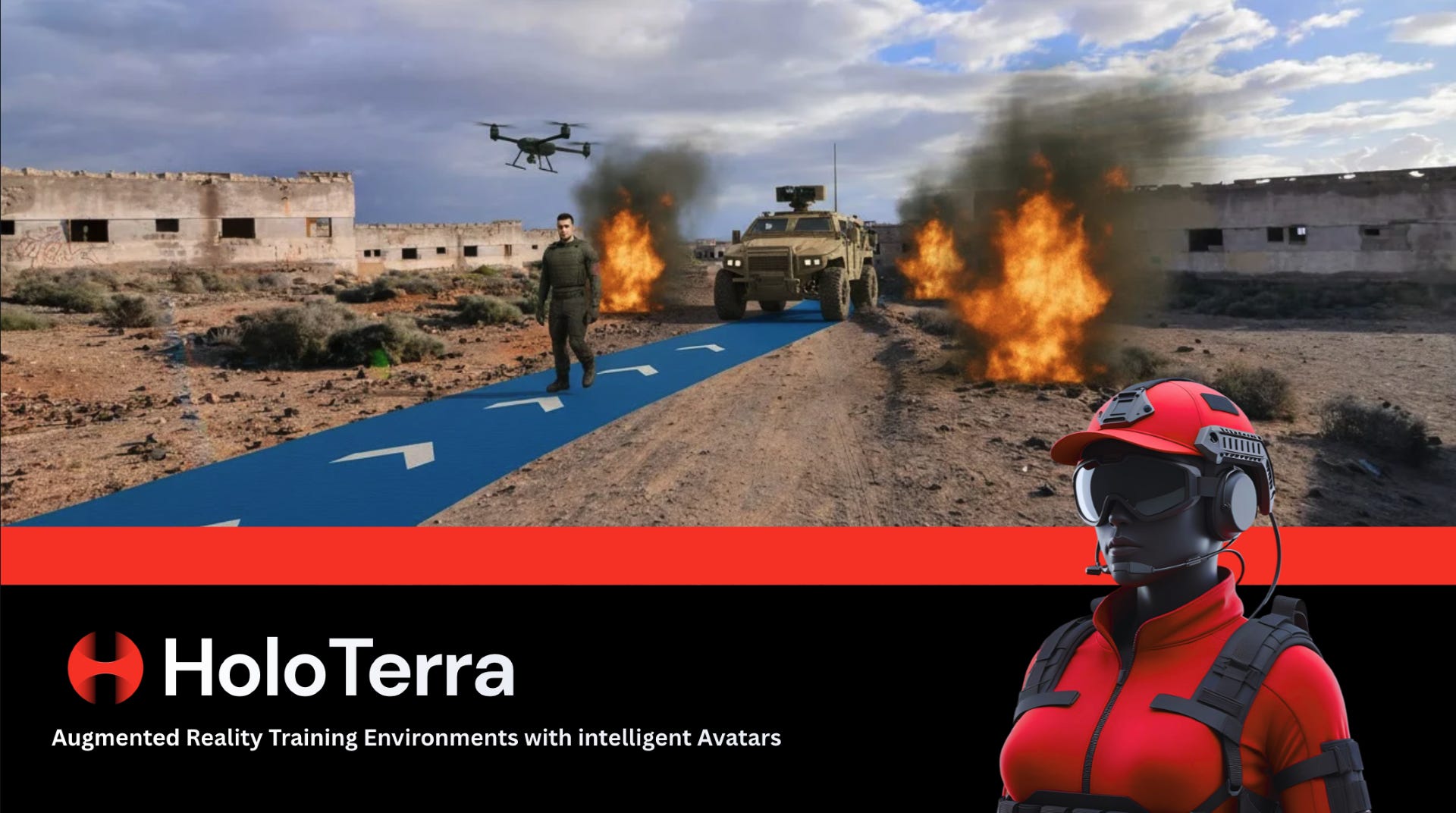
Sheila Harding is the Founder and CEO of HoloTerra, an Oklahoma City–based tech startup building Extended Reality (XR) ecosystems that merge spatial computing, AI, sensor fusion, and autonomous avatar agents. HoloTerra works across industries with use cases in commercial, defense, and nonprofit.
From Dancer to Tech CEO
Her origin story is less a linear career ladder, and more a collision of disciplines.
“I had a really unique start into the world. I was mostly in entertainment as a kid. I started out as the baby on the Roseanne show with my twin sister. We did other roles - commercials, movies - but I was a literal baby. I didn’t talk or have lines. I was just cute.
Growing up, that gave me an introduction into theater. I became a dancer. Dance was my entire life. And then at home, on weekends, I’d be on the computer - designing things, teaching myself to code, building websites. That started when I was about thirteen.
That multi-faceted skillset - performer and builder - began to converge. As Harding grew into adulthood, she choreographed tours and music videos while quietly sustaining herself through web development and digital design, becoming a top-performing partner at Wix. When COVID hit, those two worlds collided in a way that forced reinvention.
“When COVID hit, I became the go-to digital person for the arts. The dance community was like, ‘We need to get our studios, our rehearsals, everything online.’ The industry was crashing. And so I started thinking of creative ways we could do that - but it was limited, because we were all in different places.
“That’s what led me into exploring virtual reality (VR). Microsoft HoloLens was a good outlet at the time. That led me to go back to school and study VR, to launch a web agency, and eventually turn freelance work into a digital marketing agency.”
Nonprofits, government agencies, and corporate entities began asking Harding not just to build websites, but to create these interactive, spatial, and meaningful experiences that she was pioneering.

Enter Stage Left… HoloTerra
Sheila founded HoloTerra in 2021 with a clear architectural philosophy - cutting-edge, highly interactive, spatial systems. This technology has the capacity to do everything from train warfighters, simulate emergency response scenarios, guide tourists through a museum, and tell interactive stories.
“Our HoloTerra product, Augmented Reality Pathways (AR Pathways), takes the idea of walking through augmented reality - still a choose-your-own-adventure, still interactive - but you’re being led along a path. We’ve already done the patent paperwork to turn it into a search engine.
On the commercial side, we build interactive movies with deeper storytelling experiences that you can physically walk through.
And on the public safety and defense side, it’s training and simulation - everything from training warfighters to predicting evacuation routes.”
The vision was validated early by an unlikely catalyst - historic preservation.
“I was in a room with city planners and preservation leaders, and they asked, ‘What digital creative media ideas could we bring to life?’ I was the only digital media person there. I had this idea - and I thought, this is where I shoot my shot. The Preserve Route 66 Grant Fund from the National Trust for Historic Preservation funded our first augmented reality movie, one of the first in the world of its kind.
I saw immediately how scalable it could be - every city, every state, every industry. And it’s evolved so much since then.”
Remember Pokémon Go?
Harding often traces the original problem she wanted to solve back to a long-standing frustration with interactive media.
“I always thought interactive film would be very cool - Netflix interactive films, early video game experiments. But it always fell flat.
The question was - how do you make it more natural? And I realized when you take a scene or a movie and play it out in a spatial environment, people can make choices the way they do in real life. Am I going this direction or that direction? Do I engage with this avatar or sit in that chair?”
That insight - spatial choice as the user interface - reframed the problem entirely.
“Using my dance choreography brain, I could take that a million directions. I wanted to build something like a search engine for spatial experiences - a true interactive film network.”
Today, that concept extends far beyond entertainment. She describes her work fundamentally as data visualization of environments, not stagnant dashboards. If that sounds abstract, she offers a simple reference point.
“At the end of the day, this is data visualization. Information, and how you see it. Pokémon Go is a great simplified example - seeing a character in the real world. But when that character is spatially aware, knows where walls and objects are, knows where you are and - can be a part of an entire interactive scenario while it has an AI brain in it - that’s where we are right now.”
What is a “Spatial Avatar?”
One of HoloTerra’s most advanced components is a “spatial avatar.”
“A spatial avatar is an AI character that can navigate your physical environment. It knows where the walls are, where the chair is, where objects are, and where you are. It can interact to a degree.”
“It can’t do anything a ghost couldn’t do. It’s essentially a hologram.”
Where HoloTerra differentiates is intelligence and integration.
“In defense, a lot of simulations are not only locked in a computer. Even when they are in XR, the avatars often just stand there. They’re limited in animation, spatial understanding, and intelligence. But if you’re training, you need an adversary actor that behaves like a real person or a battlefield assistant.”
“We’ve named ours LANA — the Live Augmented Network Assistant. The idea is that the brain of this avatar can connect into databases and systems.
What’s interesting is that the military has always been the leading buyer of augmented reality and heads-up display for as long as the technology has existed. They’ve spent more money on it than anyone else ever and they’ve been doing the most advanced work in that realm.”
Through LANA, users can visualize and interact with real operational data fueled by AI and machine learning.
“We’ve been working with DINA, the Defense Innovation Navigation Assistant from NavalX which is a database of military innovation. As a mission planner, you can communicate with this avatar and ask, ‘What are the possibilities for innovation here for my need?’ It can pull from approved data and emerging technologies.”
What Was Once Novel, Is Now Becoming Critical
In mission-critical environments, Harding sees augmented reality not as a novelty, but as a necessity.
“Simulation is using digital twins and 3D models to replicate scenarios - not just outcomes of an operation, but how it affects the world, the media, everything.
Augmented reality is beneficial when you need to understand how things interact with the real world - and when people who aren’t in the room need to participate.”
By visualizing complex defense ecosystems spatially, HoloTerra is helping stakeholders navigate an otherwise opaque system.
“Defense innovation is incredibly complex. You’ve got databases like DINA, Vulcan, Outrider - all trying to match technologies with program managers and sponsors.
What we’re doing is visualizing that type of data in a simulation environment - and now moving toward mission planning.”
Oklahoma City’s Opportunity to Lead as a Smart City
The vision extends beyond defense into smart cities - a place where Oklahoma is uniquely positioned to lead.
“Smart cities are really just more intelligent cities. That could mean autonomous drones, faster emergency response, automated maintenance, civic engagement - the list goes on.
Cities can get incredibly accurate maps - down to where potholes are, whose grass needs to be cut. That capability already exists.”
HoloTerra does important work in this arena for public safety and civic engagement. The challenge, she says, isn’t technology. It’s mindset.
“Oklahoma has the ingredients - geospatial, sensors, energy, engineering, aviation, autonomous systems. But sometimes we need to get out of our own way.
People need to stop being afraid of looking weird. Innovation feels weird at first.”
She sees parallels between Oklahoma’s oil and gas legacy and global smart-city investments.
“Places like Saudi Arabia are investing oil wealth into smart city infrastructure. Oklahoma has similar assets. We should be diversifying into modernization - not just infrastructure, but operations, transportation, tourism, entertainment.”
Oklahoma won’t outspend Silicon Valley, but it can out-ship it. Leveraging our industry bases here to include defense, aerospace, energy, and agriculture, we can become the US testbed for rapid AI deployment.
The AI Market for Oklahoma
“Data centers and power are a great first move. Energy is critical to AI, and Oklahoma’s already a big player.
But then the question is: what do we do with it? What real problems are we solving?
There’s good work here - accelerators, programs - but investors are often unfamiliar with dual-use commercial and defense tech commercialization.
AI has become a clickbait term. Some people slap an AI sticker on things. Real innovation is solving real problems and iterating with end users. AI is more than a new way to Google recipes. It’s an evolution of automation that we should be putting into the real world to make Oklahoma better. Augmented reality is becoming an interface for that.”
What we talked about was vertical integration for our Oklahoma AI economy - ideas taken all the way through implementation.
“If we don’t do that, we’re just building nice toys. I’d like to see Oklahoma take more bold steps in innovation. Don’t play it so safe. Investors putting their money in AI need to think beyond SaaS platforms.
We’ve recently been approached by a Fortune 500 company here to help us scale. We are announcing our partnership soon. The mission set supports fielding military innovations at wartime speed using emerging innovation data visualizations and operational feedback during simulations. It’s a closed loop system that HoloTerra designed. We’re welcoming mission partners and developers.”